
News & Publications
Share
Types of Noise Walls and Sound Control Solutions
Whether it’s the constant hum of highway traffic or the mechanical pulse of construction zones, unwanted sound follows every new development. Across Australia, engineered noise walls have become a necessary part of the landscape. They determine how infrastructure fits into its surroundings and how residents experience nearby transport routes.
At Kubri Engineered Solutions, our partnership with Panacor brings global expertise in acoustic technology to local projects. We supply advanced noise walls and barrier systems that are designed and adapted for Australian conditions.
This blog will explore the different types of noise walls, what makes them effective, and the advanced solutions available to manage noise in your next project.
What Defines an Effective Noise Wall?
A well-engineered noise wall is an acoustic system built to control how sound moves through space. The goal is to prevent noise from reaching sensitive areas such as homes, offices, hospitals, or public spaces. Achieving that comes down to how sound waves are absorbed or deflected by the wall’s structure.
Performance is measured using key acoustic classifications:
- Weighted Sound Reduction Index (DLR): Measures how much sound is reflected toward the source. Materials with higher DLR values are more reflective.
- Sound Absorption Index (DLα): Measures how much noise energy is absorbed within the barrier itself. Higher DLα ratings mean better absorption.
An effective noise wall must also withstand real-world conditions. Its structural integrity and long-term performance are influenced by wind loads, vibration, temperature changes, and ultraviolet (UV) exposure.
Types of Noise Walls and Sound Control Solutions
1. PMMA Acoustic Noise Walls
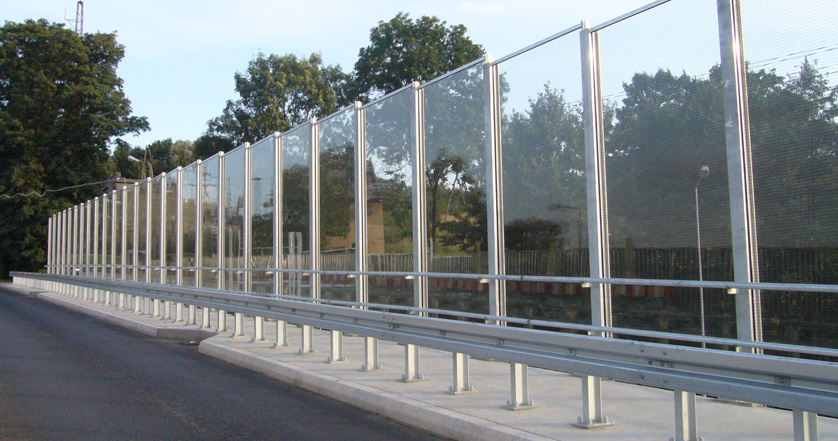
Polymethyl methacrylate (PMMA), also known as Plexiglas, Lucite, or Perspex, is a high-performance thermoplastic commonly used in transparent acoustic barriers. Compared with glass, PMMA offers more than ten times higher impact resistance at roughly half the weight.
Acrylic panels also maintain their clarity over decades thanks to their exceptional UV stability. PMMA does not yellow or lose its stiffness under prolonged exposure to sunlight, ensuring consistent performance in harsh Australian climates.
These characteristics make acrylic noise walls particularly effective where visibility and aesthetics must coexist with strong noise reduction (e.g, along elevated motorways, pedestrian bridges, scenic corridors, and residential zones)
Panacor MT15 PMMA System
This model is designed and tested to meet European standards and combines high acoustic performance with minimal visual impact.
Key specifications:
- Construction: Extruded colorless or tinted PMMA sheets fixed into galvanized steel frames fabricated to EN 10025 and EN 15773 standards.
- Acoustic classification: B3 sound insulation with DLR = 47 dB and A2 sound absorption with DLα = 4 dB.
- Durability: Excellent stability under heat and UV exposure.
- Compliance: Fully tested and certified to EN 1793 and EN 1794 standards.
2. PVC Noise Walls
Unlike traditional materials such as concrete or metal, PVC doesn’t corrode, rot, or stain, making it particularly effective in coastal and high-humidity areas. And because they’re modular and easy to install, PVC noise walls are frequently chosen for projects requiring fast deployment or reduced foundation work without compromising acoustic results.
Panacor LW70 PVC System
Panacor’s LW70 range demonstrates how modern polymers can achieve both strong noise reduction and long service life.
Key specifications:
- Construction: Panels made of recycled PVC core covered by a prime PVC-compound layer.
- Acoustic options: Reflective model (LW70 R) and Absorptive model (LW70 A)
- Dimensions: Standard profile height 151.5 mm, overall thickness 68.6 mm, with wall thickness 5 mm, available lengths from 2 to 7 m.
- Compliance: Meets ASTM E90-09 and EN ISO 10140-2:2010 standards
3. Metallic Noise Walls
Constructed from galvanized steel or aluminium, they combine dependable noise reduction with a lighter overall structure compared to concrete. Their modular design makes them ideal for large transport or industrial projects where long spans and rapid installation are priorities. Perforated surfaces can be filled with mineral wool or similar materials to improve absorption, while solid configurations focus on reflection.
Panacor AC100 Metallic System
A proven metal barrier solution that balances acoustic performance with cost efficiency. KES supplies this system for Australian infrastructure projects requiring certified strength and lightweight construction
Key specifications:
- Acoustic classification: B3 sound insulation with DLR = 26-28 dB and A5 sound absorption with DLα = 20 dB.
- Structural performance: Supports design loads up to 300 kg/m2 and test loads up to 450 kg/m2.
- Finish and protection: Thermosetting polyester powder coating ensures resistance to corrosion, heat, and continuous sunlight exposure.
4. Concrete Noise Walls
Concrete is the most recognized material in large-scale noise mitigation thanks to its density, strength, and longevity. Its mass makes it exceptionally effective at reflecting low-frequency noise from highways and rail corridors. Because concrete panels can be cast with textured or colored finishes, they also adapt well to environments that require visual harmony with surrounding structures.
Panacor HG4/47 Concrete System
The HG4/47 model combines structural reliability with strong acoustic performance, providing a durable solution for road and rail applications.
Key specifications:
- Construction: Dual-layer panel composed of reinforced HA 30 concrete with a porous sound-absorbing layer to combine strength and acoustic efficiency
- Acoustic classification: B3 sound insulation with DLR = 47 dB and A2 sound absorption with DLα = 4 dB.
- Compliance: Fully tested and certified under EN 1793 and EN 1794 standards.
5. Wooden Acoustic Walls
Wooden noise walls combine natural aesthetics with reliable acoustic control, making them a preferred option for residential and environmentally sensitive areas. Their visual warmth reduces the industrial appearance often associated with noise barriers. When properly engineered, layered timber systems can achieve noise reduction by combining reflective and absorptive components. The front slats reflect mid-frequency noise, while mineral wool or similar infill materials absorb higher frequencies.
Panacor MD11 Wooden System
KES provides this system in Australia for projects that require both environmental integration and dependable acoustic efficiency.
Key specifications:
- Material origin: Made from Sylvester pine sourced from Sweden or Finland, treated to Class 4 durability in a vacuum autoclave with steam injection.
- Acoustic classification: B3 sound insulation with DLR = 29 dB and A3 sound absorption with DLα = 8 dB.
- Structural performance: Mounted on HEA/HEB metal posts with welded base plates (grade S275JR per EN 10025), galvanized and spray-coated per EN 1461 and EN 15773.
- Applications: Residential zones, parks, landscaped highways, and community developments.
6. Mixed Material Noise Walls
Mixed or composite noise walls combine multiple materials to achieve balanced acoustic and visual performance. Instead of relying on a single characteristic, such as the reflection strength of concrete or the transparency of PMMA, these systems merge complementary materials to optimize results.
A common configuration places dense concrete or metal panels at the base for reflection, with transparent PMMA above to preserve visibility and avoid the ‘tunnel effect’ that can occur when solid barriers are built close to residential areas.
Panacor’s mixed systems combine PMMA, wooden, metal, or concrete elements depending on acoustic priorities and visual context. The result is a barrier system that can respond to both engineering and planning needs to mitigate noise effectively while integrating into the local environment.
Explore the full set of Panacor noise walls or download the brochures for detailed specifications and performance data here.
Broader Sound Control Strategies
In many urban and residential settings, complementary measures work alongside structural barriers to create quieter, healthier environments.
- Green Walls and Vegetative Barriers: Layers of living plants absorb and scatter sound while improving air quality and visual comfort. These systems can reduce background noise by about 10 decibels on average.
- Acoustic Windows: Using laminated or multi-pane glass separated by gas-filled layers, these windows can significantly reduce noise from the outside.
- Urban Planning: Strategic zoning that separates residential areas from industrial or transport-heavy areas is an effective long-term approach to noise control.
KES and Panacor: Leaders in Noise Control
On paper, noise walls have one goal: to create quieter spaces for the people who live and work nearby. Achieving that at the scale of transport and infrastructure projects takes more than high-performance materials. It requires careful design and a partner who understands how design affects performance in the field.
Through our partnership with Panacor, Kubri Engineered Solutions brings internationally certified systems to Australian projects, including advanced noise walls, wind barriers, fire protection panels, and enamel steel panels. This collaboration blends Panacor’s global engineering expertise with our unmatched local experience, ensuring that every system performs exactly as intended: safely, efficiently, and for the long run.
Looking for dependable sound control with thoughtful design?
Reach out to our engineering team today.